

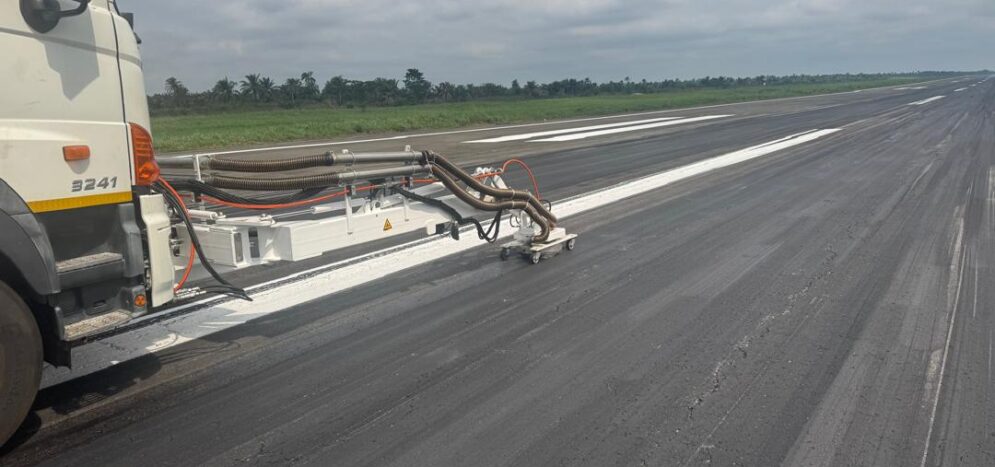
At first glance, a runway looks like little more than a long strip of asphalt with painted lines. But to a pilot, every stripe, dash, and symbol is a critical piece of information. Airfield markings are the silent language of aviation—guiding pilots during takeoff, landing, and taxiing while preventing confusion that could lead to disaster.
Whether it’s a clear summer day or a foggy night, airfield markings provide essential visual cues that ensure safe navigation and dramatically reduce the risk of runway incursions.
The Hidden Complexity of Airport Pavement Markings
Unlike road markings, which simply separate lanes or indicate turns, airfield markings follow strict international standards (ICAO) and national regulations (such as FAA Advisory Circulars). Every marking has a specific color, dimension, and placement—all designed to be understood instantly by pilots from any country.
Two color rules you can count on:
- White markings = Runway-specific information
- Yellow markings = Taxiway and holding area information
Mixing them up is not an option. That’s why maintenance and visibility are non-negotiable.
Types of Airfield Markings (And What They Mean)
Let’s break down the most important markings every airfield must maintain.
1. Runway Centerline Markings
A continuous stripe of uniformly spaced white dashes running directly down the middle of the runway.
Purpose: Guides pilots during takeoff and landing roll, helping them maintain directional control.
Why it matters: Losing the centerline in poor visibility or crosswinds can lead to veering off the runway.
2. Threshold Markings
White stripes arranged in groups on the runway’s approach end. The number of stripes indicates runway width (e.g., 4 stripes for 60 feet wide, 6 for 75 feet, 8 for 100 feet, etc.).
Purpose: Identifies the beginning of the landing zone.
Why it matters: Landing short of the threshold is dangerous; landing beyond it wastes stopping distance. Threshold markings eliminate guesswork.
3. Runway Designation Markings
Large white numbers (and sometimes letters) at each runway end, such as “09” or “27R.” These indicate the runway’s magnetic heading.
Purpose: Helps pilots identify the correct runway, especially at airports with multiple parallel runways.
Why it matters: A pilot landing on the wrong runway—or the wrong end of a runway—is a serious safety incident.
4. Taxiway Centerlines
Solid yellow lines (or double yellow lines with dashes at intersections) guiding aircraft from runways to aprons, gates, and hangars.
Purpose: Keeps aircraft on designated taxi paths, away from obstacles and active runways.
Why it matters: Following taxiway markings prevents collisions with other aircraft, vehicles, or ground equipment.
5. Holding Position Markings (Runway Hold Short Lines)
Four yellow solid lines alternating with four yellow dashed lines across the taxiway pavement.
Purpose: Marks the point where aircraft must stop unless cleared onto the runway.
Why it matters: This is the last line of defense against runway incursions. Crossing without clearance is a serious violation and a major accident risk.
6. Other Critical Markings
- Runway edge markings (white continuous lines defining runway boundaries)
- Displaced threshold markings (white arrows indicating a landing zone shift)
- Closed runway markings (yellow X’s at each end)
- ILS critical area markings (protecting navigation signal integrity)
Why Clear Markings Matter for Safety
Faded, worn, or non-compliant markings are not just an aesthetic issue—they are a safety hazard.
Here’s what properly maintained markings accomplish:
- Reduce pilot confusion – Instant recognition means fewer wrong turns or missed hold points.
- Improve operational efficiency – Aircraft taxi faster and more confidently when markings are clear, reducing delays.
- Enhance safety during low visibility – In rain, fog, or night operations, reflective markings are often the only reliable visual reference.
- Prevent runway incursions – The FAA cites runway incursions as a top safety priority. Clear hold position markings are a direct countermeasure.
- Ensure regulatory compliance – Failed inspections due to poor markings can lead to fines, restrictions, or closure of runways.
Maintenance Is Key: Why Markings Fade and What to Do About It
Airfield markings do not last forever. In fact, they degrade faster than most people realize.
Common causes of marking failure:
- Aircraft tire wear – Heavy jets repeatedly rolling over centerlines erode paint within months.
- Rubber buildup – Rubber deposits from landings cover and obscure markings.
- Weather exposure – UV rays, rain, freeze-thaw cycles, and deicing chemicals break down paint.
- Pavement repairs – Patching or crack sealing often destroys adjacent markings.
Best practices for marking maintenance:
- Conduct monthly visual inspections (and after any pavement work).
- Perform night inspections to check retroreflectivity under low light.
- Repaint on a scheduled cycle (annually for high-traffic areas, every 2–3 years for low-traffic zones).
- Use durable materials like waterborne paint with reflective glass beads or long-life thermoplastics.
- After rubber removal, always inspect and refresh markings—the removal process can strip paint.
Conclusion: Small Marks, Massive Responsibility
Airfield markings may seem simple, but their role in aviation safety is enormous. A single faded hold line or missing threshold mark can contribute to confusion, incursions, or worse.
For airport operators, maintaining clear, compliant, and reflective markings is not optional—it is a core safety obligation.
For pilots, understanding what those white and yellow lines mean is just as critical. When both sides do their part, the result is safer, smoother, and more efficient operations from takeoff to taxi and back again.